Topology
We can divide the entire network topology area into three areas:
1. Connections
Wired connections | Wireless connections |
|---|---|
| Coaxial cabling | Wi-Fi |
| Glass fiber cabling | Cellular |
| Twisted-pair cabling | Satellite |
| 2. Nodes - Network Interface Controller (NICs) |
|---|
| - List item - Repeaters - Hubs- Bridges- Switches- Router/Modem - Gateway -Firewalls |
Network nodes are the transmission medium's connection points to transmitters and receivers of electrical, optical, or radio signals in the medium. |
Classifications
We can imagine a topology as a virtual form or structure of a network. This form does not necessarily correspond to the actual physical arrangement of the devices in the network. Therefore these topologies can be either physical or logical.
Network topologies are divided into the following eight basic types:
| Topology | Function | Diagram |
|---|---|---|
| Point-to-Point | In this topology, a direct and straightforward physical link exists only between two hosts. Point-to-point topologies are the basic model of traditional telephony and must not be confused with P2P architecture). | 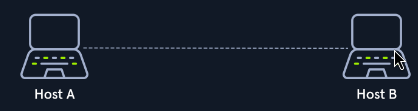 |
| Bus | Every host has access to the transmission medium and the signals that are transmitted over it. | 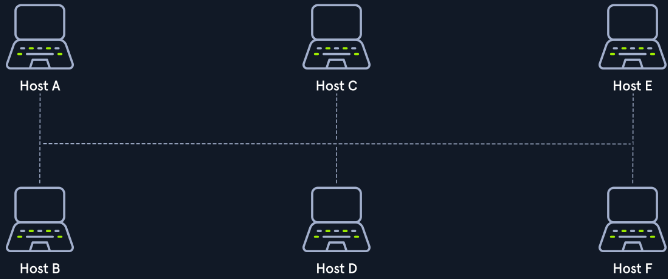 |
| Star | Each host is connected to the central network component.This is usually a router, a hub, or a switch. These handle the forwarding function for the data packets. | 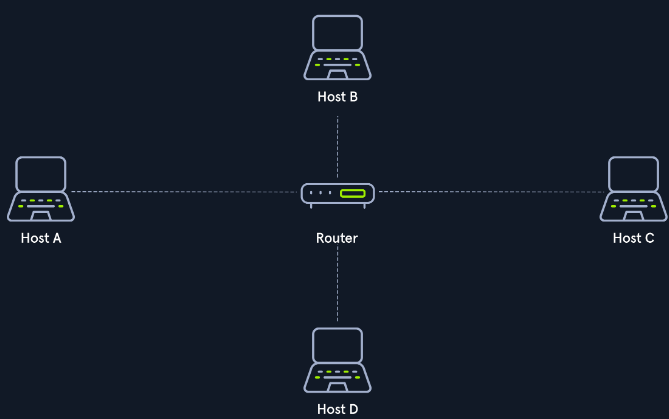 |
| Ring | The physical or logical ring topology is such that each host or node is connected to the ring with two cables:- One for the incoming signals and- the another for the outgoing ones.The information is transmitted in a predetermined transmission direction. Typically, the transmission medium is accessed sequentially from station to station using a retrieval system from the central station or a token. A token is a bit pattern that continually passes through a ring network in one direction, which works according to the claim token process. | 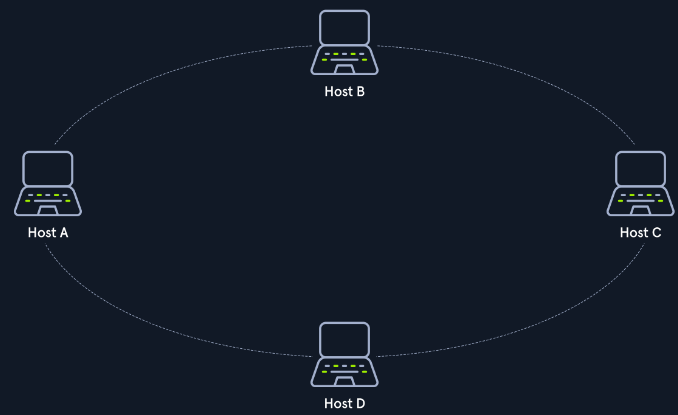 |
| Mesh | Many nodes decide about the connections on a physical level and the routing on a logical level in meshed networks. This technique is primarily used in WAN or MAN to ensure high reliability and bandwidth. | 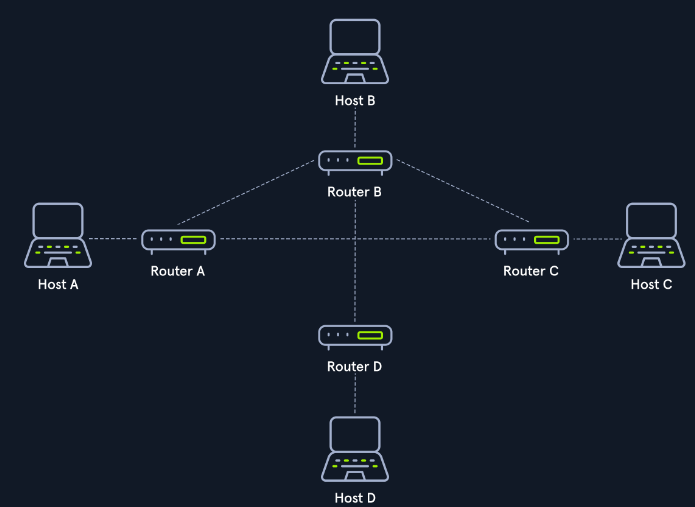 |
| Tree | Tree topologies are also used for broadband networks and city networks (MAN). | 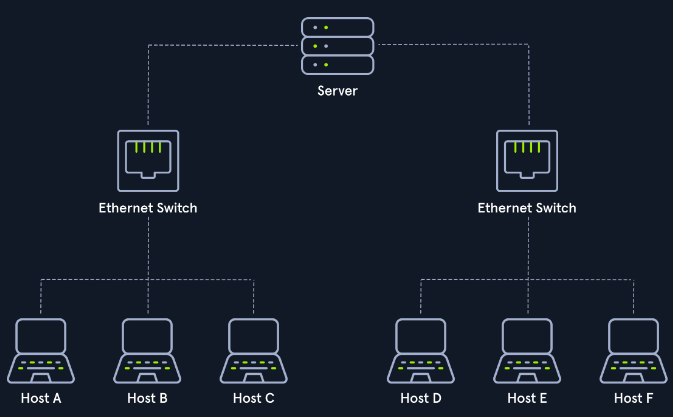 |