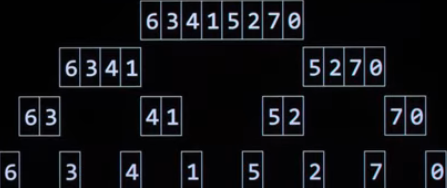
Algorithms
A code is a representation of an algorithm.
Exercises in the CS50 codespace, folder lec3algo
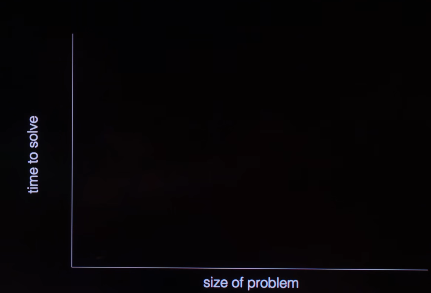
X-axis = Problem size
Y-axis = Time to computer
Time complexity:
- Usually for time-complexity analysis in algorithm performance , the upper bound of is denoted with big O
- The lower bound denoted by omega symbol
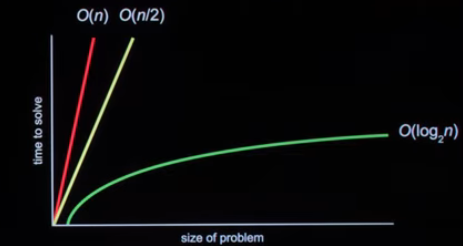
Big O notation (Big O of something)
Time main concept here is to understand how much time a program consumes while it grows: - O(n)
- Linear search algorithm: The steps taken depends of the size of N
- Best case scenario , it takes only 1 step
- O(log n)
- Binary search : As N gets large, binary search is much faster. Assuming the numbers are sorted, It divides N by half over and over again. (Because the logic is based on searching for greater than OR lower than)
- Still best case scenario it takes only one step, after dividing
- O(n^2)
- O(1)
Linear Search:
Searching from left to right OR from right to left in an array.
Example of linear search implementation with numbers:
linearSearch.c
#include <stdio.h>
#include <cs50.h>
int main(void)
{
	// Create an array of numbers

	int numbers[] = {1,20,30,6,50,10,230,100,500,25};
	int n = get_int("Number: ");

	for (int i = 0; i < 10; i++)
	{
	if (n == numbers[i])
	{
		printf("number found\n");
		return 0;
	}

	}
	printf("not found\n");
	return 1;
}
Example of linear search implementation with strings:
- Using string compare function
strcmp - strcmp takes 2 arguments
- t returns 0 if found
- returns positive or negative number if not found
betterLinearSearch.
#include <stdio.h>
#include <cs50.h>
int main(void)
{
	// Create an array of strings
    string strings[] ={"cat","dog","penguin","iron","cannon","boot"};
    string s = get_string("What are you looking for? \n");

    for (int i = 0; i < 6; i++){
        // Using string compare from the string library
        // strcmp takes 2 arguments
        // it returns 0 if found
        // returns positive or negative number if not found
        if (strcmp(strings[i],s) == 0)
        {
            printf("Found!\n");
            return 1;
        }
    }
    printf("not found...\n");
}
Data types:
Define a new data type that is a data structure with keywords : typedef struct
- Define inside the curly brackets the data types to link
- define outside the curly brackets the structure name
typedef struct
{
	string name;
	string age;
}
person;
- Then create a new array with a defined length that will have two data types under the person structure:
#include <stdio.h>
#include <cs50.h>
typedef struct
{
	string name;
	string age;
}
person;

int main(void)
{
	person people[3]
}
We define an array of people with the relative name and numbers:
#include <stdio.h>
#include <cs50.h>
typedef struct
{
	string name;
	string age;
}
person;

int main(void)
{
	person people[3]

	people[0].name = "David";
	people[0].number = "20";

	people[1].name = "Luca";
	people[1].number = "22";

	people[2].name = "Sara";
	people[2].number = "18";
}
Implement the search algorithm:
- include
string.hlibrary - compare
people[i].namestoname - Return the relative age from
people[i].age
#include <stdio.h>
#include <cs50.h>
#inlcude <string.h>

typedef struct
{
	string names;
	string age;
}
person;

int main(void)
{
	person people[3]

	people[0].names = "David";
	people[0].number = "20";

	people[1].names = "Luca";
	people[1].number = "22";

	people[2].names = "Sara";
	people[2].number = "18";

	string name = get_string("Name: ");

    for (int i = 0; i < 3; i++)
    {
        if (strcmp(people[i].names, name) == 0)
        {
            printf("%s\n", people[i].age);
            return 0;
        }
    }
    printf("Not found\n");
    return 1;
}
Binary Search:
Binary search is a highly efficient algorithm used to find a specific item in a sorted list by repeatedly dividing the search space in half.
- Binary search requires sorted data:
- selection sort
- bubble sort
- At the beginning we start by sorting the array of numbers

Check sorting algorithms visually here
pseudocode for a selection sort
O(n^2)
For i from n to n-1
	find smallest number between numbers[i] and numbers[n-1]
	swap smallest number with numbers[i]
pseudocode for a bubble sort
O(n^2)
reperat n times
	for i from 0 to n-2
		if numbers[i] and numbers[i+1] out of order
			swap them
	if no swaps
	quit
- it's comparing to n-2 because there is an operation that checks numbers[i+1]
- If it was n-1 as before , when checking the last element n-1 , the operation [i+1] won't have anything to compare it to.
- Visual explanation here
Recursion:
It's a function that call's itself
-
Uses base cases that responds to a simple conditional yes or no
-
code in codespace called
iterationRecursion.c -
When a function is called, that function call is put on a specific area of memory called a stack using a stack frame. Every time you call that same function new stack frame is created and they stack on top of each other, meaning these function calls are independent. Once the function returns a value, or it executes it's every line, it "returns" back to where it was called and its stack frame gets popped out of the stack. You don't need to know the specifics but realize that same function call if called multiple times, gets their own stack frame.
-
The 5 steps to implement recursion:
- Find the simplest case (base case)
- Play around with examples and visualize.
- Relate the harder cases to the simpler cases.
- Generalize pattern.
- Combine recursive pattern with base case using code.
-
Visual explanation here
#include <stdio.h>
#include <cs50.h>

//declare function prototype
void draw(int n);

int main(void)
{
    int h = get_int("Height: ");
    draw(h) ;
}

/*
Recursion implementation
*/
void draw(int n)
{
    //Base case
    if(n <= 0)
    {
        return;
    }
    draw(n-1);
    for (int i = 0; i < n; i++)
    {
        printf("#");
    }
    printf("\n");
}
Similar to: 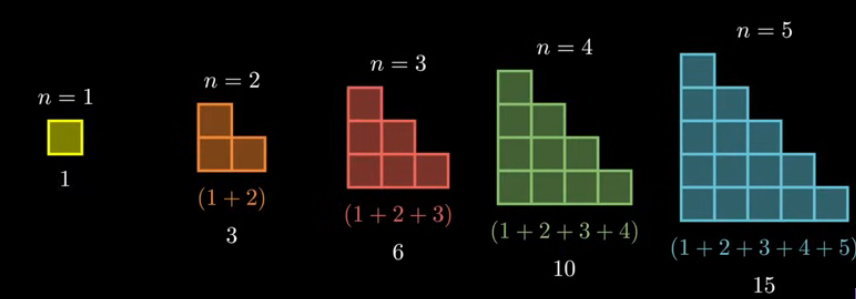
Merge sort:
Faster than selection sort and bubble sort. Psuedocode:
if only one number
	quit
else
	sort left half of the numbers
	sort right half of the numbers
	merge the sorted halves
step 1:sort the left half
[6,3,4,1,5,2,7,0]
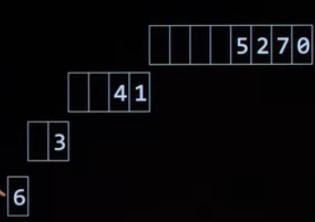
step merge them: