Welcome to C
#C
The exercises are in VScode/Learning/
The code that human writes, is called source code.
A computer that takes source code and translates it in machine code, is called a compiler.
- When writing a program in c, the extension is
hello.c - To run the program, we need to run the
makecommand that compiles the source code into machine code. - Then we run the program with
./which indicates the current file in the current folder.
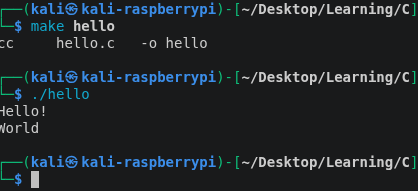
Write your first program:
#include <stdio.h>
int main(void)
{
printf("Hello \n World!");
}
printf
Print format statement in C is printf('') , in Python is print('')
Escape sequences:
\n= New line\r= Goes all the way to the write\'= Tell the problem to print only the quote character\''= Or double quote character
Header file .h
C header files end with the extension.h , which are C libraries.
So any time we want to use specific pieces of code, even printf we need to import the header files.
#include <stdio.h>
The printf function is contained in the Standard I/O header file.
Documentation for C libraries from CS50
At the beginning I'm using the <cs50.h> library which probably includes all the libraries. (Only cloud based vscode version)
User input
Whenever printing something, we need to define the type of data we are taking as input.
#include <stdio.h>
#include <cs50.h>

int main()
{
printf("Hello!\n");
string answer = get_string("What is your name?\n");
#input function = get_string
printf("hello, %s\n" , answer);
# placeholder  %s to define string type
# /n prints a new line, moving cursor to a new line
}
For the moment I'm using the CS50 library that includes all the input functions such as:
get_stringget_int
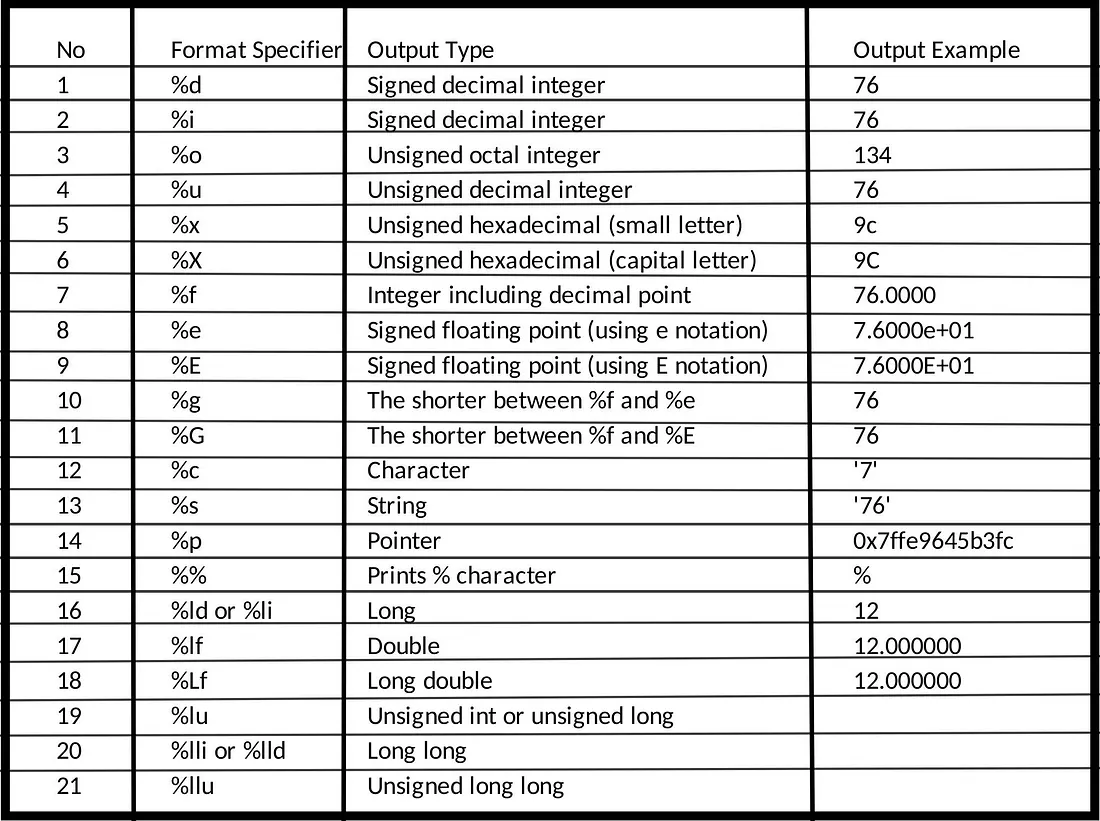
Whenever we want to print a specific data type, we need to define the format specifier in C, which is used to tell the compiler about the type of data to be printed or scanned in input and output operations.
- A format specifier always starts with a percentage sign
%, followed by a letter.
Variables:
Create a variable:
counter = 1;
# or
counter = counter = 1;
# or
counter += 1;
# or
counter++;
Comparisons
#include <stdio.h>
#include <cs50.h>
int main(void)
{
int x = get_int("what is x? ");
int y = get_int("what is y? ");

if (x > y)
{
printf("x is bigger than y\n");
}

}
Comparing singe characters
- In C when you want to compare single characters, use
''single quotes. - When is a string, with multiple characters, use
""double quotes
#include <stdio.h>
#include <cs50.h>
int main(void)
{
	char c = get_char("Do you agree? ");
	# declare char type variable
	if (c == 'y')
	{
	printf("agreed.\n");
	}
	else
	{
	printf("Not agreed\n")
	}
}
The function get_char enforce only single character, because we declared the variable char.
Same code but with logical operator OR
#include <stdio.h>
#include <cs50.h>
int main(void)
{
	char c = get_char("Do you agree? ");
	# declare char type variable
	if (c == 'y' || c == 'Y')
	{
	printf("agreed.\n");
	}
	else
	{
	printf("Not agreed\n")
	}
}
Conditionals : While
#include <stdio.h>
#include <cs50.h>
int main(void)
{
	int i = 0;
	while (i < 5)
	{
	printf("I'm increasing..%i\n", i);
	i++;
	}
}
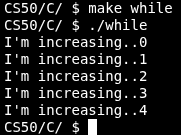
NOTICE
- i'm using the formatter
%ito print the int value as well. - Careful that the loop has an exit code, otherwise it can become an infinite loop.
- In case
ctrl + cinterrupts the program.
- In case
For
#include <stdio.h>
#include <cs50.h>
int main(void)
{
	for (int i = 0; i < 3; i++)
	{
	printf("I'm a cat\n");
	}
}
- Initialize the variable
- Check the condition
- and execute the counter
Combination of while-for loop
#include <stdio.h>
#include <cs50.h>
int main(void)
{
	int n;
	while (true)
	{
		n = get_int("How many times should the cat meow? \n");
		if (n < 0)
		{
			continue;
		}
		else
		{
			break;
		}

		for (int i = 0; i < n; i++)
		{
		printf("meow\n");
		}
	}
}
In line 5 i'm declaring the variable outside the scope of the loops so it can be used in both loops
One of the best practice is that in C, the main function contains the entire code so it should be at the top, always.
Functions:
When a function has void, it takes no input.
#include <stdio.h>
#include <cs50.h>
int main(void)
{
	meow();
}

void meow(void)
	{
		printf('meow');
	}
Note that because the function is below and outside the main function, it won't be called or it will return error, like this:
CS50/C/ $ make cowFuncWithInput
cowFuncWithInput.c:9:5: error: call to undeclared function 'meow'; ISO C99 and later do not support implicit function declarations [-Wimplicit-function-declaration]
    5 |     meow();
      |     ^
fatal error: too many errors emitted, stopping now [-ferror-limit=]
2 errors generated.
make: *** [<builtin>: cowFuncWithInput] Error 1
CS50/C/ $ ^C
CS50/C/ $
It's mandatory that the code is inside the main function
Prototype for functions
A prototype is a declaration to the compiler that at some point, there will be a function.
#include <stdio.h>
#include <cs50.h>

//Signature
void bark(void)

int main(void)
{
	for (int i = 0; i < 5; i++)
	{
		bark();
	}
}

void bark(void)
	{
		printf('woof');
	}
So I declare the function before the main func. , and can define it after the main func.
functions taking input:
#include <stdio.h>
#include <cs50.h>

// Signature moo function
void moo(int n);

int main()
{
	int n = get_int("How many times?\n")
	// Pass the user input as function argument
	moo(n);
}

void moo(int n)
{
	for (int i = 0; i < n; i++)
	{
		printf("moooo!\n");
	}
}
Notice that in line 9 there is an input variable :
- The input is used as argument for the function
- We also need to declare inside of the function above in line 5 and below in line 14 the input.
- ==We can change the argument name on both line 5 and 14 and the code will work the same.
==
Same as:
#include <stdio.h>
#include <cs50.h>

// Signature moo function
void moo(int mooTimes);

int main()
{
	int n = get_int("How many times?\n")
	// Pass the user input as function argument
	moo(n);
}

void moo(int mooTimes)
{
	for (int i = 0; i < mooTimes; i++)
	{
		printf("moooo!\n");
	}
}
Printing out a row of bricks : 2D matrix
#include <stdio.h>
#include <cs50.h>

//Create a 3x3 block of hashes
//Creating two loops
int main(void)
{
	//Outer loop - for each row
	for (int i = 0; i < 3; i++)
	{
	//inner loop - for each column
		for (int j = 0; j < 3; j++)
		{
		printf("#");
		}
	printf("\n");
	}
}
How to improve better code design?
- Use a constant for a value that you know won-t change.
- Do not use hard coded numbers like 3
#include <stdio.h>
#include <cs50.h>

//Create a 3x3 block of hashes
//Creating two loops
int main(void)
{
	//Define a constant value
	const int n = 3
	//Outer loop - for each row
	for (int i = 0; i < n; i++)
	{
	//inner loop - for each column
		for (int j = 0; j < n; j++)
		{
		printf("#");
		}
	printf("\n");
	}
}
- line 9 defines constant
- line 11 and 14 use constant
Integer overflow:
It's a situation where a variable type has a specific memory size (bit allocation) and it exceeds its allocation ,which is called overflow.
Exercise : Make a calculator in C